The AI Implementation Spectrum: 5 Levels Every Business Should Know
Most businesses are stuck at Level 1 or 2. Here's the full AI implementation spectrum and a framework to find where yours fits.

I keep having the same conversation with new clients. They tell me they’re “using AI” because they set up a Zapier workflow last quarter or they’ve been prompting Claude for content ideas. Both are valid starting points. But they’re Level 1 and Level 2 on a five-level spectrum, and their competitors are already building at Level 3 and 4.
After 23+ years in technology and 10+ years consulting for Fortune 500s, I’ve found that most implementation failures happen because businesses don’t understand where they sit on this spectrum. They either try to jump too far ahead or stay stuck at the basics far too long.
Here’s the framework I use with every client to assess where they are, where they need to be, and what it takes to get there.
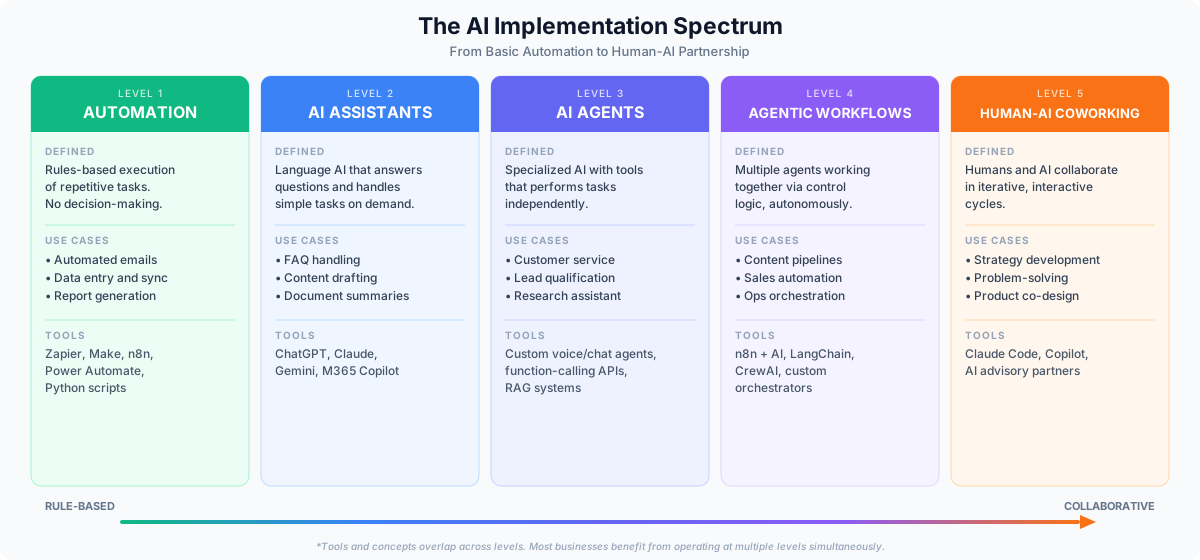
Level 1: Automation
Rules-based execution of repetitive tasks. You define the rules, the system follows them. A form comes in, an email goes out. A CRM row updates, a Slack notification fires.
This is the foundation. Every business should have this locked down before moving up.
Real example: A client’s intake form was manually processed by two staff members, 4 hours daily. We built a Make workflow that routes submissions to the right team, creates CRM records, sends confirmation emails, and logs everything in a Google Sheet. Time saved: 18 hours weekly. Total build time: 6 hours. The system has run without intervention for 9 months.
Tools: Zapier, Make, n8n, Power Automate, Python scripts
Who this is for: Every business. If you’re still doing repetitive data entry by hand, start here before considering anything else.
Level 2: AI Assistants
AI that understands natural language to provide information and complete simple tasks. Someone on your team uses ChatGPT to draft emails, summarize documents, or brainstorm ideas.
This is where most businesses operate today. It’s productive on an individual level, but it’s personal productivity, not operational efficiency. The AI doesn’t know your clients, can’t access your systems, and stops working the moment someone closes the chat window. That gap between Level 2 and Level 3 is where most businesses stall.
Real example: A 12-person consulting firm had each consultant using Claude for client research and proposal drafts. Each person saved 3-5 hours weekly. Solid results. But the AI wasn’t connected to their CRM, didn’t know their pricing, and couldn’t work without a human typing prompts every time. Individual gains, zero operational impact.
Tools: ChatGPT, Claude, Gemini, M365 Copilot
Who this is for: Teams ready to boost individual productivity. But don’t stop here.
Level 3: AI Agents
Specialized AI with tools and capabilities, designed to perform specific tasks independently. Agents don’t wait for prompts. They have access to your systems and execute tasks on their own. An assistant answers when you ask; an agent works when you don’t.
This is where competitive advantage starts showing up in your numbers.
Real example: We built a voice agent for a property management company that handles after-hours calls. It answers tenant questions about maintenance status (pulling live data from their ticketing system), schedules emergency repairs with approved vendors, and qualifies prospective tenants with the right screening questions. Monthly calls handled: 340+. Leads qualified: 47. Cost: $200/month in API fees. Their previous answering service charged $1,800/month and missed 30% of calls.
Tools: Custom voice/chat agents, function-calling APIs, RAG systems
Who this is for: Businesses with high-volume, repeatable customer or internal interactions. If you’re paying for an answering service, a lead qualification team, or a front-desk coordinator, Level 3 is your next move.
Level 4: Agentic Workflows
Multiple AI agents coordinated by control logic, working together autonomously across multi-step processes. At this level, you’re building systems where agents hand off work to each other, make decisions, and complete end-to-end workflows without constant human oversight.
The jump from Level 3 to Level 4 requires clear process documentation, reliable data infrastructure, and a human-in-the-loop for edge cases (at least initially).
Real example: A marketing agency I work with built an agentic content pipeline. Agent 1 monitors industry feeds and identifies trending topics. Agent 2 researches and outlines articles. Agent 3 writes drafts in the brand voice. Agent 4 generates images and social assets. A human reviews final output before publishing. What used to take their 3-person content team a full week now takes 2 hours of review time. Content output tripled. Cost per piece dropped 74%.
Tools: n8n + AI nodes, LangChain, CrewAI, custom orchestrators
Who this is for: Businesses with documented, multi-step processes that follow consistent patterns. Content operations, sales pipelines, and client onboarding are common starting points.
Level 5: Human-AI Coworking
Humans and AI systems collaborate in iterative, interactive cycles with shared decision-making. At Level 5, AI isn’t executing predefined workflows. It’s thinking alongside you, contributing ideas, challenging assumptions, and iterating on complex problems that require judgment.
I operate at Level 5 daily. My AI systems research market trends, draft strategy recommendations, build prototypes, and manage content operations. I provide direction, make judgment calls, and handle client relationships. The output would require a 6-person team. It’s me and my AI partners.
Real example: When a nonprofit client needed a complete digital transformation plan, my AI system and I co-developed it over 3 days. The AI researched comparable org transformations, identified grant funding opportunities, mapped their tech stack gaps, and drafted implementation timelines. I guided strategy, held stakeholder conversations, and ensured recommendations aligned with their mission. The deliverable typically takes a 4-person consulting team 3-4 weeks. We delivered in 3 days at 40% the cost.
Tools: Claude Code, GitHub Copilot, AI advisory partnerships
Who this is for: Consultants, agencies, and knowledge workers who are ready to change how they deliver value. This level requires treating AI as a collaborator, not just a tool.
Where Does Your Business Fit?
Here’s a quick assessment. Answer honestly.
| Question | If Yes… |
|---|---|
| Do you have automated workflows for repetitive tasks? | Level 1+ |
| Is your team using AI chat tools for daily work? | Level 2+ |
| Does AI handle customer-facing or internal tasks independently? | Level 3+ |
| Are multiple AI systems coordinating end-to-end processes? | Level 4+ |
| Are you and AI co-creating strategy and complex deliverables? | Level 5 |
Most businesses I assess score Level 1-2. The ones pulling ahead are pushing into Level 3.
How to Move Up the Spectrum
Each level builds on the one before it. Here’s how to move:
Level 1 to 2: Get your team trained on AI assistants. Set clear usage guidelines. Measure individual time savings weekly for 30 days.
Level 2 to 3: Identify your highest-volume, most-repetitive interaction. Customer support calls, lead intake forms, appointment scheduling. Build one agent for that single use case. Start narrow, expand after 60 days of data.
Level 3 to 4: Document your core business processes end-to-end. Map which steps can be handled by specialized agents. Build the orchestration layer connecting them. Plan for 4-8 weeks of build and testing.
Level 4 to 5: This is a mindset shift more than a technology shift. Start by co-developing one complex deliverable with AI. A strategy document, a product spec, a client proposal. Iterate together rather than delegating tasks. Build trust through repetition.
The Cost of Staying Put
Every month you stay at Level 1-2 while competitors move to Level 3+, the gap compounds. A business operating at Level 3 saves 15-30 hours weekly in staff time. At Level 4, they’re producing 3-5x the output with the same headcount. By Level 5, they’re delivering work that would require hiring 4-6 additional people.
The tools are ready and affordable. The question is whether you move now or wait until a competitor makes that decision for you.
Your next step: Book a discovery call and I’ll tell you exactly where your business sits on this spectrum and what it’ll take to move up one level.
TAGS
Ready to Take Action?
Whether you're building AI skills or deploying AI systems, let's start your transformation today.
Related Articles

Microsoft Is Building AI Without OpenAI
Microsoft launched 3 in-house AI models through Foundry, signaling the end of OpenAI exclusivity. See what this means for your enterprise AI vendor strategy.

Gemma 4 Just Made Your API Bill Optional
Google's Gemma 4 runs frontier-quality AI on one GPU with zero per-token fees. Discover how SMBs can self-host and slash inference costs to near zero.

OpenAI's IPO Is Coming. Your AI Budget Is Next.
OpenAI killed Sora, pivoted to enterprise, and targets a $1T IPO. Discover how vendor IPOs flip AI pricing and what to lock in before contracts reset.